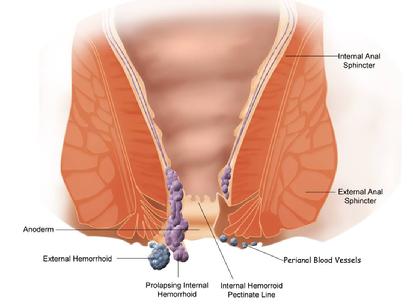
I think I have hemorrhoids. Can they be treated at the time of my colonoscopy?
Two treatments can be performed at Digestive Health or Mercy Regional Medical Center* while you are sedated for colonoscopy:
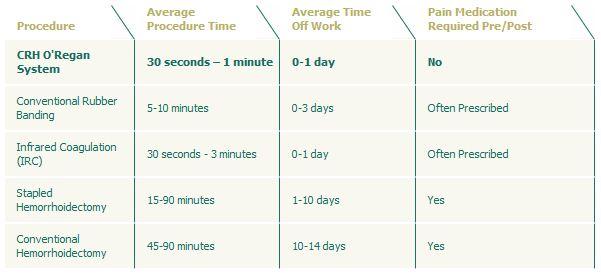
Band ligation - from "conventional" ligation to CRH O'Regan ligation system (see below)
Hemorrhoidal band ligation can be easily performed at the completion of a colonoscopy. Banding is also easily performed in the office. Office-based banding does not require bowel cleansing or enemas, or sedation.
The doctor uses a device known as a ligator inside the rectum (above the border of sensitive anal canal skin) to suction the loose tissue at the base of the hemorrhoid into a small cup around which a tiny rubber band is placed, leaving a small firm ball of tissue about the size of a blueberry. With conventional banding techniques including those using devices that attach to flexible endoscopes and devices used through an anoscope (now used infrequently at Digestive Health), up to three bands may be placed during a treatment session. While the performance of conventional banding itself is painless under sedation, it is not unusual for patients to awaken with an aching anorectal discomfort. Usually this subsides over the course of an hour or so, but occasionally it will require treatment with sitzbaths and medication for a day or more. In contrast, CRH O'Regan system banding (see below) is generally painless or associated with only minimal transient post procedure discomfort whether or not sedation has been administered.
The healing process involves clot formation (thrombosis) in the affected hemorrhoid and sloughing of the banded tissue over the course of a week or so. While this is often a painless process, in some cases pain, protrusion of the thrombosed hemorrhoids and bleeding can be significant problems. Rare but potentially life-threatening infections have been reported after banding, so it is important to keep your doctor informed if you are having any persistent or worsening symptom such as pain, particularly in the presence of fever or chills, after this treatment. Band ligation may be safely repeated, and multiple treatment sessions are often needed to achieve maximal benefit.
At our endoscopy facility and clinic conventional hemorrhoidal banding has been largely replaced by CRH O'Regan banding, a procedure we have found to be much better tolerated.
CRH O'Regan banding (see below) is rarely associated with significant pain or serious complications. Most patients need 3 band placements to achieve an optimal outcome. The first placement can be performed at the completion of your colonoscopy. Additional band placements are typically performed at 2-3 week intervals in our outpatient clinic. No preparation, cleansing or sedation is needed for these follow up visits.
Infrared coagulation (IRC)
IRC uses an infrared light source to heat (photocoagulate) pea-sized dots of skin in the rectum just above the hemorrhoid. Typically, 6-12 coagulations are performed in a session, moving around the circumference of the lower rectum. This treatment is painless when performed under sedation immediately following the completion of your colonoscopy. Recovery is usually immediate. A mild aching discomfort occasionally follows treatment for up to an hour. As the healing process begins to occur in the days following treatment some minor bleeding is typical, as the coagulated tissue begins to slough.
This treatment works in part because the healing process leads to beneficial scar tissue formation which "tacks" the loose hemorrhoidal tissues to the underlying rectal wall and reduces blood flow into the remaining hemorrhoidal channels. IRC rarely leads to significant complications but multiple treatments are often necessary to achieve maximal benefit. IRC in our experience is less effective than band ligation and its use in our practice has been largely replaced by the use of CRH O'Regan band ligation.
If you are experiencing hemorrhoidal symptoms and want your gastroenterologist to consider performing one of these treatments please discuss this with us before your procedure.
Hemorrhoid Treatment Aftercare for infrared coagulation and conventional band ligation
*CRH O'Regan band ligation is not available at Mercy Regional Medical Center
|